Market Entry Analysis: AI-Assisted IELTS Preparation
Section 1. Problem Statement
Client: Independent course creator (anonymized)
Research conducted: March 2026
Analys: Product & Business Analys
The client needed to validate one business question before investing in course production: Is there real, monetizable demand for an AI-assisted IELTS preparation course and what does that audience actually need? The decision to proceed with user testing, advertising, or full production depended entirely on the answer. The course was to be positioned as a self-development and productivity product, not a language school.
Three decisions needed evidence:
- Is the market growing or saturated?
- What are the exact pain points of paying learners?
- Which platform and positioning give the best entry point?
Technical Overview
This research was built on a custom Python pipeline. Data collection, cleaning and AI analysis were each handled by dedicated scripts no third-party research tools or manual aggregation.
Full codebase:
github.com/Elli55/ielts-with-ai-market-researchPipeline files:
- config.py — Central configuration
- scram_google_trends_statistic.py — Google Trends time series
- scram_google_trends_topics_and_risig.py — Related queries
- scram_youtube.py — YouTube video statistics collector
- youtube_comment_total.py — Full comment dataset collector
- youtube_comment_ai.py — AI-filtered comment collector
- ai_analys_youtube.py — Gemini batch analysis — YouTube
- ai_analys_udemy.py — Gemini analysis — Udemy
Section 2. Research Strategy
Four sources. Each answered a different business question.
Google Trends mapped search demand over 12 months and identified when AI entered the IELTS space at scale a critical timing signal for the client's launch decision. Related queries revealed adjacent audience interests, informing both positioning and content architecture.
YouTube provided unfiltered, public audience behavior. IELTS learners document real failures and specific frustrations in comment sections qualitative data that surveys rarely capture. Video statistics identified which content formats drive engagement, revealing gaps in the existing supply.
Udemy served as the commercial benchmark. Comments from paying customers not just viewers gave direct insight into purchase expectations and product disappointments on the exact platform the client is targeting.
Google Gemini API processed 3,000+ collected comments systematically. At that volume, manual analysis introduces inconsistency. Batch processing ensured every comment received equal analytical weight. All AI outputs were reviewed and interpreted before conclusions were drawn.
Section 3. Search Demand- What does the market say?
Finding 1. Related searches What does the audience want?
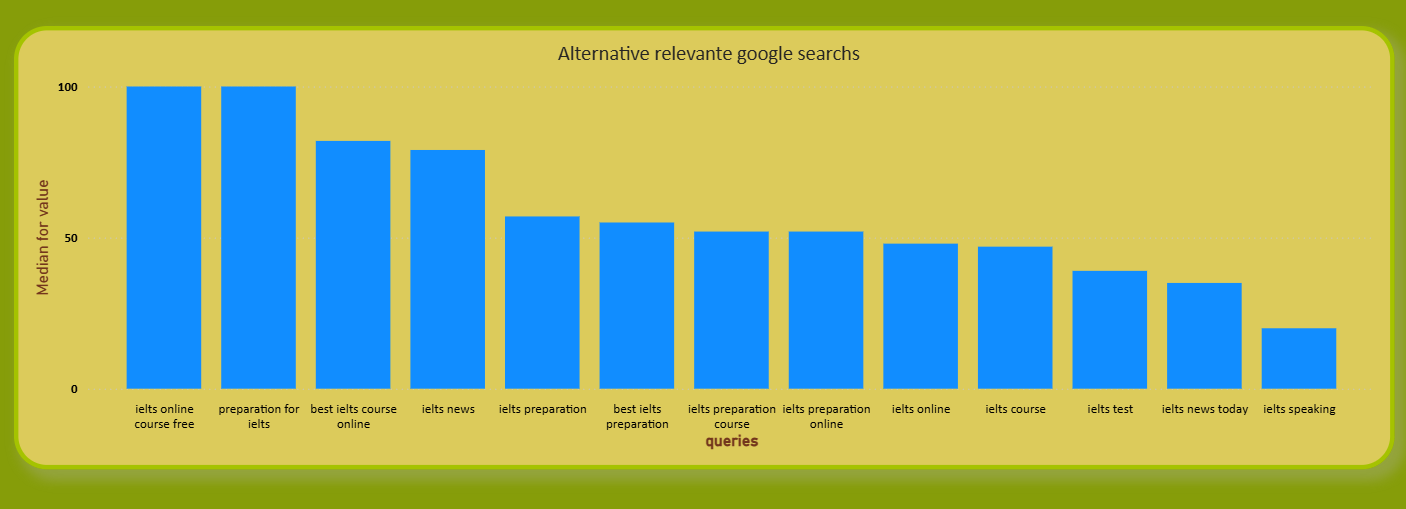
This shows two things. First, people want a course, not only information. Second, the keyword "free" has very high search volume. The course will be paid, but it is good to add something free inside the course. For example: template, prompt pack, or checklist. If we write in the title or description that the course includes “free” materials, more people can click. The word "free" also works in psychology. When people see "free inside", the course looks more valuable. This can increase clicks and also sales. Because of this, price strategy should also think about this point.
Traditional IELTS searches - Seasonality signal
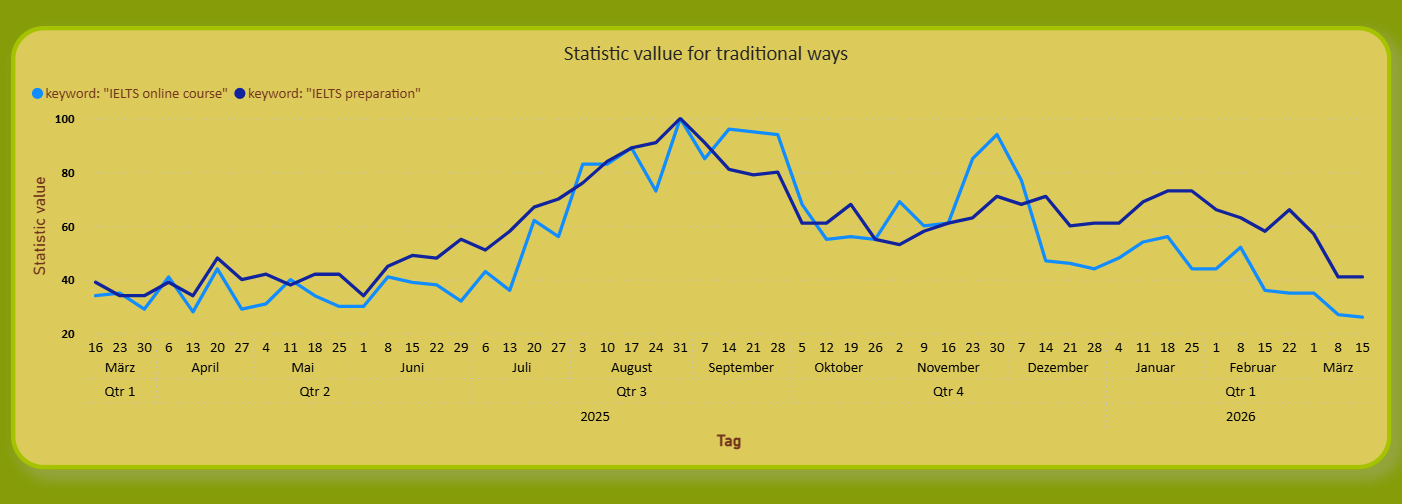
In winter, search is lower. This happens because university application time is in this period. For marketing, promotion should start in March or April. Then the course will be ready when demand goes up. This seasonality is also useful for content plan. Messages like "3 months before exam" or "last weeks before IELTS" work better in this time.
AI-based IELTS searches - Trend is starting
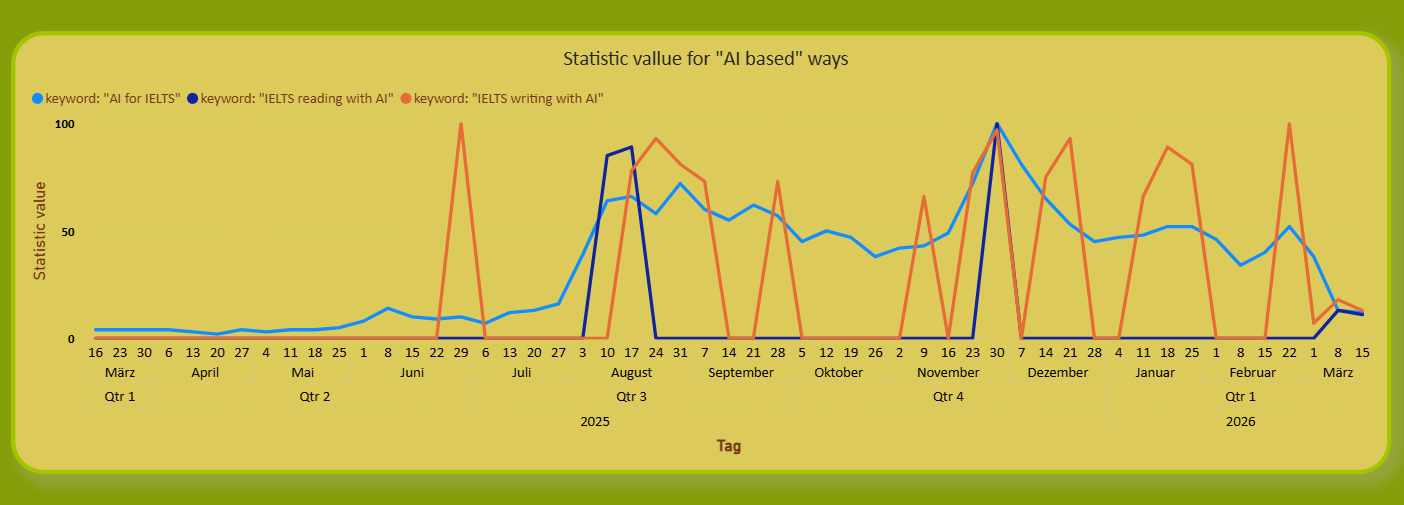
Searches like "AI for IELTS", "IELTS writing with AI", and "IELTS reading with AI" start to grow in the second half of 2025. The trend is not stable yet, but the direction is clear. YouTube videos about this topic started at the same time. This means content creators already start to build demand, but the market is not full yet.
Finding 2. YouTube Competitor Landscape
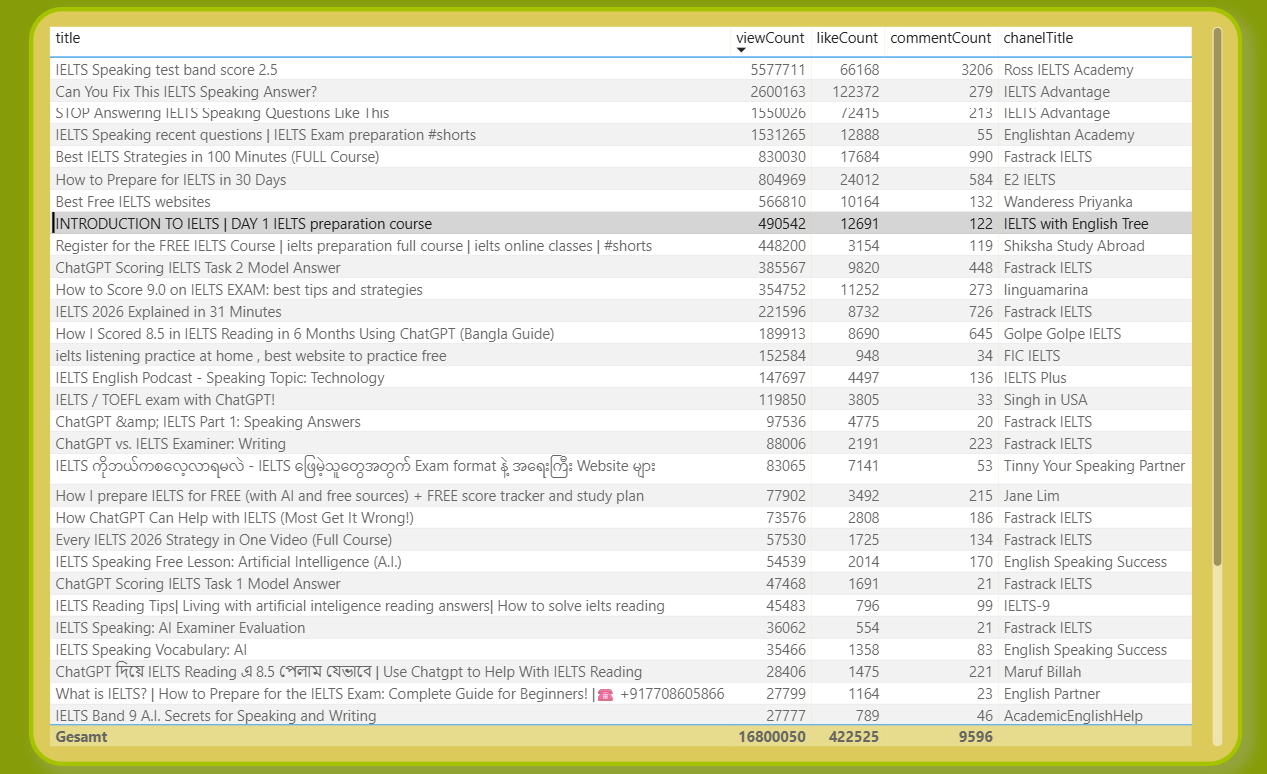
First, the keyword "free" is used systematically in titles "Best Free IELTS websites", "Register for the FREE IELTS Course", "How I prepare IELTS for FREE". This confirms the signal we saw in Google Trends: the audience is searching for free resources, and content creators intentionally include this word in their titles. Second, the existing competition in the AI topic is almost completely concentrated around ChatGPT, "ChatGPT Scoring IELTS Task 2", "How I Scored 8.5 Using ChatGPT", "ChatGPT vs. IELTS Examiner". There is no strong competitor built around Gemini, Claude, or a structured prompt methodology. This gap is a direct opportunity for differentiation.
Videos appearing for top IELTS keywords have collected more than 16 million views, 422K likes, and 9,596 comments in total. These numbers clearly show the scale of demand in the market. Two conclusions can be read directly from the table.
Comment Share by Channels- Fastrack IELTS Effect
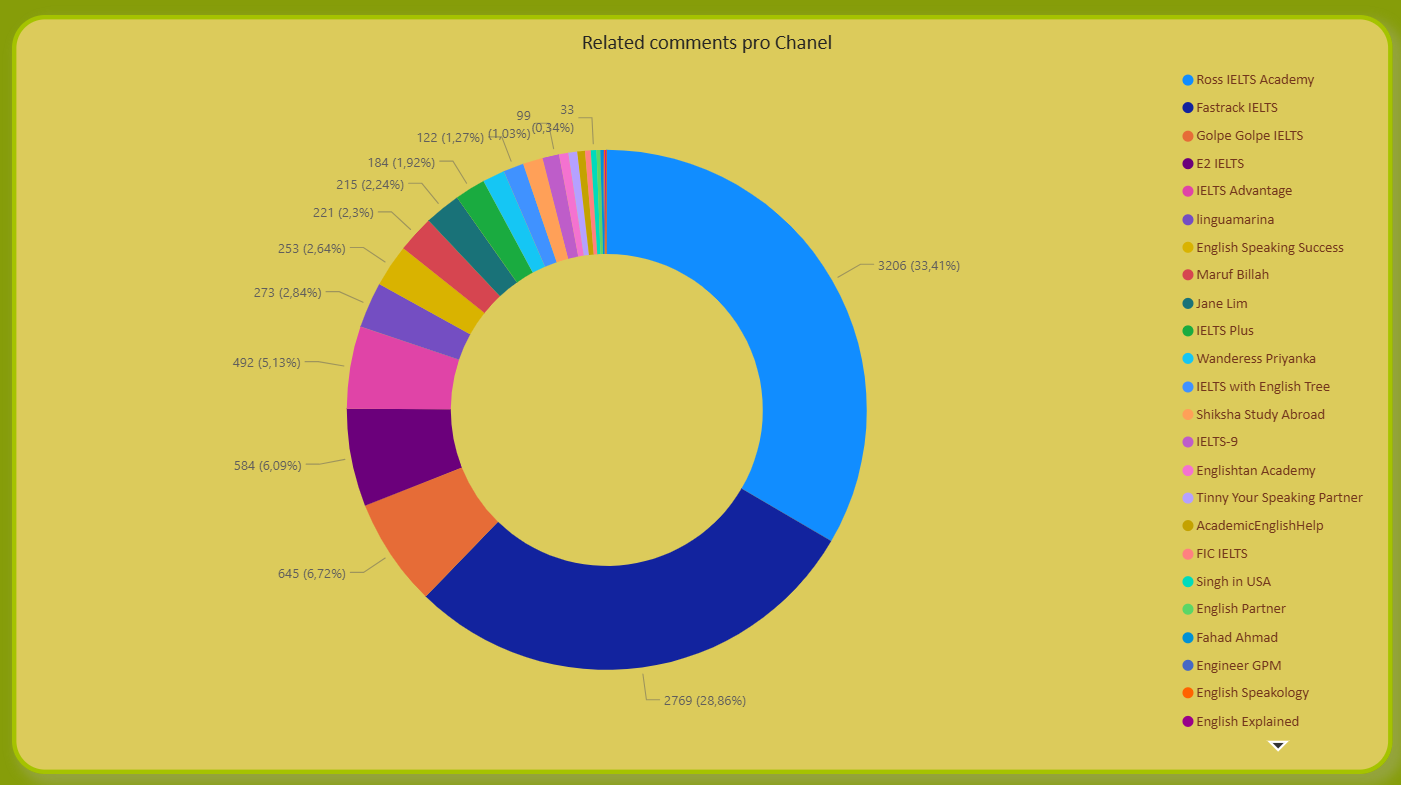
Ross IELTS Academy has 33% of the total comments, and Fastrack IELTS has 29%. YouTube is a free platform the number of views shows interest, but the number of comments measures real audience activity. These two numbers show that Fastrack is a dominant competitor in the market. Out of 7 videos shared by Fastrack, 4 are directly about AI IELTS integration. The titles of the other 3 are direct, honest, and promise- based there is no misleading clickbait. The audience clearly responds to this approach: high comment activity proves this.
In the course naming, description, and in the title of every module, this model should be considered: say clearly what you teach, and give what you promise. Fastrack’s success is not a brand effect, but the result of a content design decision. Each title is a mini-promise by itself. This can also be applied to course architecture the name of every module should answer the question “what will you learn”, not just show the topic.
Finding 3. AI Analysis of YouTube Comments
Technical note: The data analyzed in this section was obtained via YouTube Data API v3 from the comment sections of the videos whose statistics were shown in the previous section.
More than 2,500 YouTube comments collected were not directly usable for analysis. In the first stage, the data was cleaned: entries shorter than 10 characters, comments consisting only of emojis, and meaningless text fragments were removed. The cleaned dataset was processed through the Gemini-3-flash-preview API in batches of 200. Each batch was analyzed independently, and then all results were synthesized into a single final report in the second stage. The goal was simple: with this volume of user stories, it is not practically possible for a human to read each comment one by one and convert them into use cases. AI standardized this process — every comment received the same analytical weight, neither the first 200 comments nor the last 200 comments had any advantage.
The results are below:
Business Analysis Report: IELTS Preparation Market & User Insights
1. Executive Summary
The IELTS preparation landscape is characterized by a high-stakes, high- anxiety environment where users are increasingly turning to digital solutions but facing significant friction. While there is overwhelming gratitude for high-quality instructional content, a massive gap exists between automated AI feedback and actual exam standards. The audience consists primarily of international students and professionals aiming for Band 7.0–9.0, many of whom are operating under extreme time pressure and financial constraints.
2. Top Problems (Tactical Hurdles)
AI Scoring Inaccuracy & Inconsistency: A critical issue where tools like ChatGPT are perceived as "too strict" or "stingy," frequently scoring users at a 6.0 when they are performing at a 7.5+ level. This creates a "false ceiling" that discourages learners.Extreme Time Constraints: A recurring pattern of "emergency preparation, with users starting their study 24 hours to 2 weeks before the exam, leading to "brain shutdown" and panic.Technical & Administrative Friction: Broken links to resources (specifically Cambridge books 18–20), SSL security issues on practice sites, and withheld results in specific regions (e.g., Canada) causing visa delays.
- Reading: Difficulty with "Headings," "Yes/No/Not Given," and time management in Passage 3.
- Writing: Confusion over Task 1 flowcharts/processes and maintaining "academic" vs. "natural" vocabulary.
- Speaking: High anxiety and "spelling disease" (nervous mistakes) during live interaction.
Specific Skill Plateaus:
3. Main Pain Points (Emotional & Systemic)
Psychological Burnout & "IELTS Trauma": Repeated attempts and low AI scores lead to depression, insecurity, and a desire to quit. The exam is viewed by many as a "money grab" rather than a fair language assessment.Financial Gatekeeping: The high cost of exams, tutors, and prep materials creates a barrier for users in developing regions (Pakistan, Bangladesh, Uzbekistan), who lack access to credit cards or high-disposable income. Information Overload & Confusion: Learners are overwhelmed by conflicting advice regarding exam mechanics (e.g., UK vs. US spelling, capitalization rules, and the 2026 format changes).The "Authenticity" Gap: A debate over whether to use "sophisticated/pretentious" vocabulary (which AI rewards) or "natural/native" English (which examiners prefer).
4. Main Needs (Market Demands)
Reliable, Human-Level Assessment:** A desperate need for an affordable "pre-examiner" service or an AI tool specifically tuned to IELTS Band Descriptors rather than general prose. Structured Roadmaps for Beginners: "Total beginners" require step- by-step guides (e.g., "From A1 to Band 7 in 4 months") rather than fragmented tips. Direct Resource Access: High demand for one-click downloads of Cambridge practice books, Notion study templates, and "copy-pasteable" AI prompts. Localized Content: Support in native languages (Hindi, Bengali, Punjabi, Thai) to bridge the gap for students whose base English is too weak for English-only instruction. Community & Moral Support: A strong desire for study partners and "luck/prayers" from the community to mitigate exam- day anxiety.
5. Product & Business Opportunities
Specialized IELTS AI Evaluator: There is a massive market gap for an AI tool that mirrors real examiner logic (reducing the "AI stinginess" problem) and provides audio feedback for the Speaking module. "Emergency Prep" Kits: Specialized 1-day, 3-day, and 7-day "fast-track" modules designed for last-minute test takers. Localized Micro- Courses: Low-cost, native-language "bridge" courses for students in specific regions (e.g., "IELTS for Bengali speakers"). Human-in-the-Loop Feedback Services: Tiered pricing for essay grading-ranging from basic AI correction to premium "Native Examiner" deep dives.
- Alternative payment gateways (local transfers/cash) for high-demand regions.
- Visual accessibility features (Dark Mode for eye strain).
- Mobile-optimized research tools ( Olovka) for students who do not own laptops.
Operational & Accessibility Tools:
6. Overall Sentiment
Primary Sentiment: Highly Positive but Anxious. The community is fiercely loyal and grateful to creators (often using mantras like "I am a star"), viewing them as "life-savers." Secondary Sentiment: Relieved. There is a "collective sigh of relief" when users discover that their low AI scores are common and not necessarily a reflection of their true ability. Undercurrent: Skeptical & Frustrated. A growing minority is disillusioned with the "IELTS business model" and suspicious of staged mock tests or "fake" grading videos.
Finding 4. AI Analysis of Udemy Comments
Technical note: The data in this section was obtained from existing IELTS preparation courses on Udemy. The method was intentionally bipolar: comments from the1000 highest-rated students + comments from the 1000 lowest-rated students were selected. The goal was not to create a picture where “everything is good” or “everything is bad”, but to see at the same time what works and what does not work in the market. The comments were analyzed using Gemini-3-flash-preview API and Claude Sonnet 4.6 Extended.
Unlike the YouTube audience, the people who write Udemy comments are students who paid money. This difference changes the quality of the data expectations are higher, disappointment is more concrete and behind positive reviews there is a real result.
Business Analysis Report: IELTS Preparation Market on Udemy — 2000 User Insights
1. Executive Summary
The IELTS preparation market on Udemy consists of a highly motivated yet deeply frustrated audience of international students and professionals. The dominant problem does not stem from content quality itself, but from the course's value-to-price ratio: users pay for a course only to encounter information they could have found for free on YouTube. At the same time, there is virtually no serious product on the market for advanced learners who are trying to break through the "Band 6 ceiling." The formula for a successful product is straightforward: professional production + concrete strategies + a personalized feedback mechanism.
2. Top Problems (Tactical Hurdles)
Poor Production Quality: The most widespread complaint on Udemy is related to audiovisual quality — blurry video, unreadable fonts, breathing sounds, background noise, and lip-smacking. This is a particularly damaging flaw for a language exam course, where learners expect a professional environment above all else. Filler Content: Courses are artificially inflated — repetition of the same sentences, unnecessary introductory videos, and "motivational" segments. The vast majority of users feel compelled to watch at 1.5x–2x speed just to make the content bearable. The "Upsell" Trap: Throughout a paid course, students are repeatedly advertised external books, third-party websites, and additional services. Users feel this is dishonest. Academic vs. General Training Gap: The overwhelming majority of courses are oriented exclusively toward Academic IELTS. For General Training — particularly letter writing (Task 1) — there is a serious gap in the market. The "Band 6 Ceiling": A large number of users are stuck between 5.5–6.5 and need a specific course to break through that ceiling. Existing courses either remain too elementary or lack the credibility to genuinely validate Band 8+ sample materials. Outdated Content: A number of courses are based on older Cambridge books, do not cover the Computer-Based Test (CBT) format, and have not been updated to reflect the 2026 format changes. Unresponsive Support: Users never receive answers to their questions in the Q&A section; this completely erodes trust in the course.
3. Main Pain Points (Emotional & Systemic)
The "Wasted Money" Feeling: The thought of "I could have found this for free on YouTube" after paying for a course is the strongest negative emotion in the market. Users openly reference the money they have spent on previous courses and private tutors."Band 6 Depression": Remaining at the same band after multiple attempts — especially in Writing — leads to serious demotivation and a loss of self-confidence. Last-Minute Panic: A large segment of users purchases a course 3–14 days before their exam. For this group, the structure of existing courses is entirely unsuitable — because time is their most critical resource.The "Fake Band 9" Suspicion: When users find grammatical errors in materials the course itself presents as "Band 9 samples," they call the instructor's entire credibility into question. Regional Language Barrier: A portion of learners from Turkish, Spanish, Arabic, and Portuguese-speaking backgrounds cannot fully absorb English-only instruction; this significantly slows down their rate of strategy acquisition.
Band-Specific Strategies for 7–9: This is the market's largest gap. Users do not want to "learn beginner English" — they want to know exactly what it takes to pass the exam. Concrete templates, "skeleton" structures, and understanding the examiner's logic.Self-Contained Materials: Users do not want to purchase external books. PDFs, mock tests, answer keys — everything should be included within the course itself.Personalized Feedback Mechanism: Receiving individual feedback on written essays and speaking tasks is the most demanded yet the least fulfilled need in the market.Structured Roadmap: A clear study plan — "from Day 1 to Day 30" — with a clear answer to "which section do I tackle, and when."Time Efficiency (Micro-Learning): High-density, 5–10 minute lessons. Working professionals study during lunch breaks.Mobile Optimization: A large portion of learners study on mobile devices; slide fonts, contrast, and audio quality need to be separately optimized for mobile.Regional Language Support: Explaining strategies in the learner's native language (Turkish, Arabic, Spanish, Portuguese) is critical, particularly for B1– B2 level students.
5. Product & Business Opportunities
The "Anti-Boring" High-Production Course: This is where the market's biggest gap lies. A professionally edited course — free of "umms" and "ahhs," with clear audio, large fonts, and mobile-friendly design — would immediately differentiate itself. The "Band 7+ Accelerator": A specialized, intensive course for learners stuck at Band 6–6.5. No introductory content — only "marginal gains": what is the difference between a Band 6 and a 7.5, and what does the examiner actually look for. General Training Specialist: In a market where 90%+ of existing courses are oriented toward Academic IELTS, a high- quality, dedicated General Training course would capture the immigrant/worker demographic outright. Mock Test Hub: Instead of a video-heavy course, a practical simulation platform with timed tests, answer keys, and Band 9 model essays. AI-Powered Essay Evaluator: Users are desperate for personalized feedback. An AI tool that grades essays according to the instructor's specific templates — deployed through a "Human-in-the-Loop" tiered model — could be the most powerful differentiating element of a course. "72-Hour / 1-Week" Crash Kits: There is a large segment of last-minute preppers. For them: "80/20" content — 20% of the material, 80% of the results. Modular Micro-Courses: Instead of one massive 70- hour course: individual, affordable, focused modules such as "Matching Headings Masterclass," "Skeleton for Writing Task 2," and "CBT Simulator." Bilingual "Bridge" Courses: Bridge courses that explain IELTS strategies in the learner's native language (Turkish, Arabic, Spanish) — a separate and underserved market segment.
6. Overall Sentiment
Dominant Sentiment: Conditionally Positive. Users show high loyalty toward quality instructors (Vanessa, Keino, Asiya, etc.) — but this loyalty is directly tied to course quality. The moment a gap appears between what was promised and what was delivered, trust collapses immediately. Second Dominant: Skeptical & Frustrated. The feeling of financial loss, past negative experiences, and a general distrust of the IELTS "business model" recur as a strong undercurrent across all batches.Aspirations Are High. "Band 9" is referenced everywhere — this is a powerful emotional selling point in the market. Users don't just want to pass the exam; they want a breathtaking result. The Positive "Discovery" Effect. When users encounter a genuinely quality course, their reaction is extremely powerful (shifting from "I could have found this free on YouTube" to "every penny was worth it"). This indicates that a real quality gap is, in practice, very rarely encountered in the market
Section 2. Decision Framework , 7 Recommendations
Recommendation 1 - Which platform?
Decision: Udemy as main, YouTube as tunnel.
Related queries data shows that the audience is actively searching for a course. However, the Fastrack example proves that YouTube can be a strong tunnel leading to Udemy. Being only on Udemy limits visibility.
Recommendation 2 - How to position?
Decision: "AI examiner logic" not ChatGPT, but methodology.
Both YouTube and Udemy data showed the same gap: existing competition is built completely around ChatGPT, and the audience does not fully trust it. The course should not be positioned as "IELTS with AI", but as "structured AI methodology working with real examiner logic".
Recommendation 3 - How to use the keyword "Free"?
Decision: Paid course, free side product.
Both Google Trends and YouTube title data showed that the keyword "free" is a dominant search signal. If a prompt pack, template, or checklist is offered for free and highlighted in the title, both SEO and conversion become stronger.
Recommendation 4 - When to launch?
Decision: March–April, be ready for the peak.
Traditional search data shows that demand reaches its peak in May– August. Course promotion should start in March–April so that it is ready when demand increases. The message "X months before the exam" gives the highest response in this period.
Recommendation 5 - What should the content format be?
Decision: Active practice system not a content library.
Udemy data showed that the market expects a shift from the "watch" format to the "practice and get result" format. Send essay, get score this format is a differentiation point that almost none of the existing competitors can provide.
Recommendation 6 - What should the naming strategy be?
Decision: Honest, direct, promise-based titles.
The Fastrack IELTS example showed that in a market full of clickbait titles, honest and clear titles create higher comment activity. The course name and every module title must answer the question "what will you learn".
Recommendation 7 - Which different and interesting target audience segment?
Decision: Last-minute learners are the first target.
A significant part of YouTube comments comes from users who start preparation 1–14 days before the exam. This segment is both the largest and the least served group. A "7-day fast preparation" module is a direct entry product for this audience.